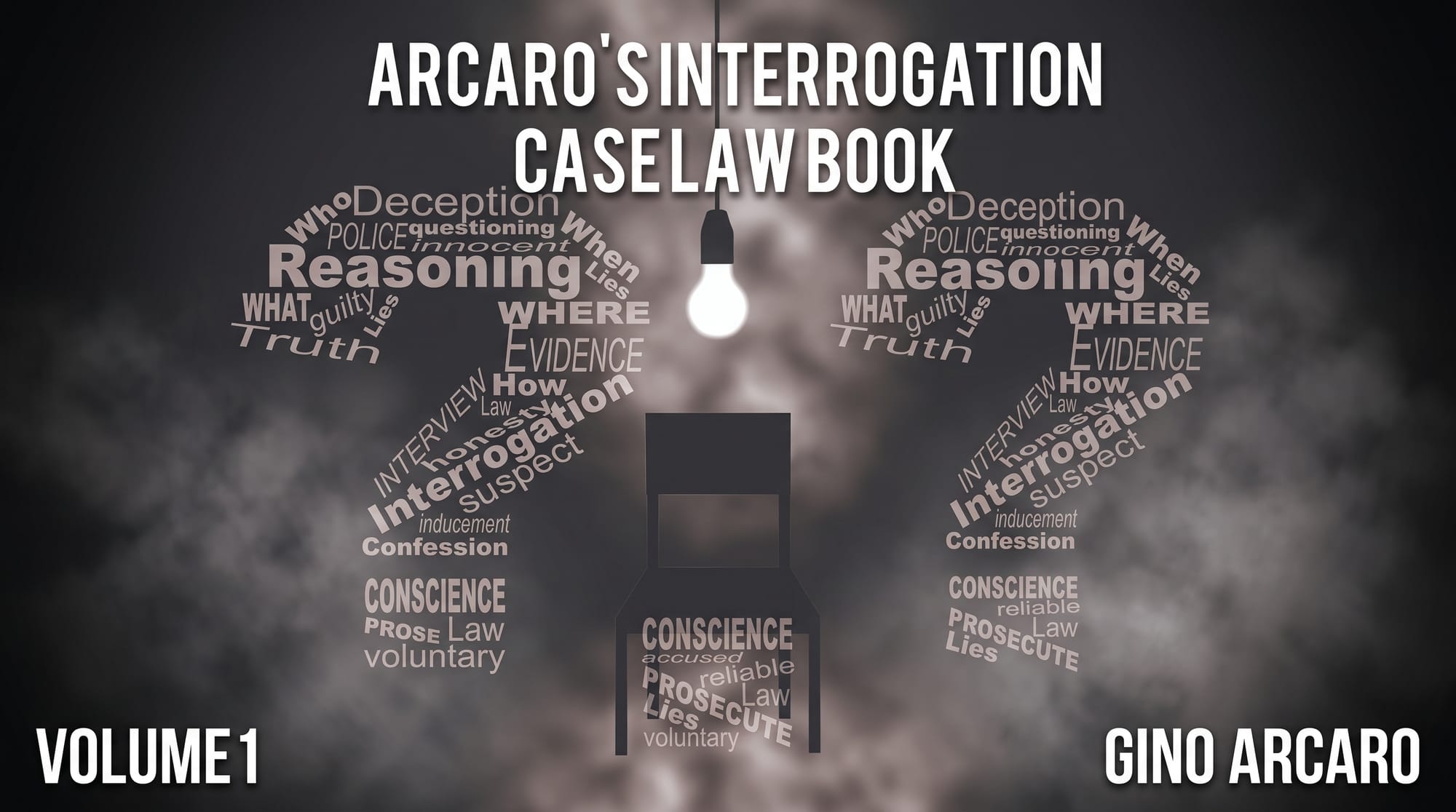
A confession obtained inside a police interrogation room represents one of the most powerful forms of evidence in the criminal justice system. However, securing a statement is only half the battle. If an investigator violates statutory procedural rules, applies oppressive psychological tactics, or disregards judicial precedents, that confession will be declared inadmissible during pre-trial voir dire proceedings. In Arcaro's Interrogation Case Law Book, former police detective, college professor, and criminal justice author Gino Arcaro provides a comprehensive legal roadmap designed to bridge the divide between conversational interviewing techniques and the rigid judicial standards governing evidentiary admissibility.
Published by Jordan Publications Inc., this 122 page specialized legal manual serves as an indispensable training and research manual for front line police officers, major case detectives, and legal scholars. Arcaro approaches the subject with a fundamental reality: true interrogation expertise does not occur by accident. It is developed through dedicated study, practical experience, and an exhaustive understanding of appellate case law. By dissecting key judicial rulings, analyzing the legal boundaries of suspect inducement, and examining the voluntariness rule, this manual equips investigators with the technical knowledge necessary to secure statements that survive aggressive constitutional scrutiny.
The Operational Dilemma: Securing Confessions That Stand Up in Court
In popular media and fictional crime dramas, police interrogations are frequently depicted as high pressure psychological duels where investigators use aggressive deception, veiled threats, or false promises to break a suspect resistance. In real world criminal jurisprudence, using such methods guarantees that any resulting admission will be thrown out of court.
Judges evaluate custodial statements under strict legal doctrines, primarily focusing on whether a statement was made freely and voluntarily. When a defense attorney challenges an interrogation, the burden rests squarely on the Crown or state prosecution to prove beyond a reasonable doubt that the investigator actions did not overwhelm the suspect free will.
If an officer misinterprets the boundary between permissible persuasion and unlawful inducement, months or years of meticulous investigative casework can be erased in a single afternoon. Arcaro's Interrogation Case Law Book addresses this vulnerability directly, providing investigators with an objective understanding of how appellate courts interpret every phase of the interrogation process.
Core Legal Frameworks in Arcaro's Interrogation Case Law Book
The manual organizes decades of complex jurisprudence into structured, actionable concepts that officers can study and apply prior to conducting custodial interviews.
1. The Common Law Voluntariness Rule
At the heart of interrogation law is the common law voluntariness test. Arcaro details the precise judicial standards judges use to assess the integrity of an interrogation:
- Threats and Promises: Understanding how subtle linguistic cues, implied leniency, or suggestions of bail assistance can constitute an unlawful inducement that invalidates an entire statement.
- Oppressive Atmospheres: Analyzing how prolonged questioning without rest, deprivation of food or medical attention, and extreme environmental conditions can lead to judicial exclusion under doctrines of police oppression.
- Operating Mind Doctrine: Evaluating whether a suspect possessed the cognitive capacity to understand what they were saying and the consequences of speaking to investigators, particularly when dealing with intoxication, mental health crises, or acute shock.
- Police Trickery and Deception: Clarifying the narrow boundaries where investigative deception is permitted, contrasted with egregious conduct that shocks the community conscience and breaches judicial integrity.
2. Safeguarding Statutory Rights and Right to Counsel
A critical focal point in Arcaro manual is the procedural implementation of constitutional protections. The book examines the legal mechanics of providing clear cautionary warnings, recognizing the immediate triggers for the right to retain and instruct counsel without delay, and managing situations where a detainee asserts their right to remain silent. Arcaro explains how to lawfully continue questioning without violating the suspect constitutional rights, ensuring that every verbal waiver is informed, unequivocal, and legally defensible.
3. Deconstructing Appellate Precedents
What makes this manual an exceptional operational reference is Arcaro methodical approach to case law analysis. Rather than summarizing court decisions in dry academic prose, he extracts the practical operational takeaways of landmark appellate judgments. Investigators learn why specific interrogations failed on appeal, identifying the precise questions, statements, or procedural missteps that caused appellate panels to overturn murder and major felony convictions.
4. Audio Visual Recording and Non Verbal Articulation
Modern criminal courts demand complete transparency. Arcaro provides detailed directives on room setup, continuous electronic recording protocols, and the contemporaneous documentation of suspect body language, emotional state, and physical requests. The text instructs officers how to create an unassailable digital and written record that eliminates defense claims of off-camera coercion or unrecorded promises.
Why Technical Legal Mastery Matters for Modern Detectives
Officers and justice professionals who study the jurisprudence within Arcaro's Interrogation Case Law Book gain distinct operational advantages:
- Elimination of Trial Surprises: Knowing the limits of permissible interrogation tactics prevents costly exclusions during pre-trial voir dire hearings.
- Protection Against Wrongful Convictions: Ethical, legally compliant interview methods minimize the risk of eliciting false confessions from vulnerable or compliant subjects.
- Enhanced Professional Credibility: Mastery of appellate case law elevates an officer standing as a professional, objective witness during cross examination.
- Foundation for Promotional Advancement: A deep grasp of criminal evidence rules and judicial precedent is a core evaluation metric for detective and supervisory promotional boards across law enforcement services.
Author Credentials and E-E-A-T Credibility
Legal instructional texts require proven, verified authority. Gino Arcaro brings exceptional background across tactical policing, investigative leadership, and post-secondary academic instruction:
- Fifteen Years of Law Enforcement Experience: Arcaro began policing at age eighteen, earning promotion to tactical SWAT team operator and subsequently to criminal detective by age twenty six. His active police service involved investigating high level criminal offenses, managing crime scenes, and conducting major case interrogations.
- Two Decades of Collegiate Teaching: Following his policing career, Arcaro dedicated twenty years to teaching police studies and criminal justice at the college level, training thousands of modern police recruits across Ontario.
- Renowned Legal Author: Arcaro is the author of six foundational law enforcement textbooks widely utilized across Ontario post secondary institutions, cementing his status as a premier educator in Canadian police procedures.
- Advanced Academic Qualifications: Arcaro holds a Master of Education degree, an undergraduate degree in social sciences, and a Level 3 NCCP Coaching certification.
- Multi Discipline Discipline and Mentorship: In addition to his criminal justice publications, Arcaro has completed over forty three consecutive years of natural weight training, founded X Fitness Welland Inc., authored the strength system eXplode, and hosts the Blunt Talk podcast, bringing an uncompromising standard of accountability to all his works.
This background guarantees that Arcaro's Interrogation Case Law Book is not abstract legal speculation, but a field tested manual informed by real courtroom challenges and classroom pedagogy.
Practical Recommendations for Interrogation Preparation
To maximize the field application of this manual, detective units and patrol investigators should adopt several operational habits:
- Review Case Law Prior to Major Interviews: Treat Arcaro manual as a pre interrogation briefing guide to review the specific legal boundaries governing the offense under investigation.
- Construct Objective Questioning Outlines: Prepare structured lines of questioning that avoid presumptive, coercive, or promise laden phrasing.
- Script Cautionary Warnings and Waivers: Standardize the delivery of right to counsel warnings to ensure every caution is fully understood and recorded without ambiguity.
- Audit Recorded Interrogations: Use Arcaro case law benchmarks to conduct internal peer reviews of completed interview recordings, identifying areas for tactical and legal refinement.
- Maintain a Dedicated Desk Copy: Keep this paperback manual in the interview prep suite as an immediate reference for on duty investigators drafting interview strategies.
Who Should Read Arcaro's Interrogation Case Law Book
- Detective Constables and Major Crime Investigators: Specialists who regularly interview suspects in homicide, robbery, sexual assault, and financial fraud investigations.
- Front Line Patrol Officers: Constables who execute initial detentions and roadside questioning where spontaneous utterances must be captured lawfully.
- Police Academy Instructors and Field Trainers: Educators responsible for teaching criminal evidence law, procedural fairness, and interview ethics to new recruits.
- Law Students, Crown Prosecutors, and Defense Counsel: Legal practitioners seeking a thorough, operational analysis of police interrogation standards and case law applications.
- Private and Corporate Investigators: Security professionals conducting workplace investigations who must respect legal parameters regarding voluntary statements.
Frequently Asked Questions
Is Arcaro's Interrogation Case Law Book an interview technique guide or a legal casebook?
It functions as both. The manual connects real world interviewing techniques directly with the statutory rules and appellate court rulings that govern confession admissibility.
Does the book address how to avoid false confessions?
Yes. By emphasizing the common law voluntariness rule, eliminating coercive inducements, and scrutinizing the operating mind doctrine, the book teaches officers how to obtain genuine, voluntary admissions.
Can this book be utilized for detective promotional exams?
Yes. The detailed coverage of evidence law, confession jurisprudence, and courtroom admissibility standards makes it an outstanding resource for investigators preparing for detective and sergeant promotional boards.
Where can purchasers obtain a copy of this publication?
The book is published by Jordan Publications Inc. and is available in paperback format on Amazon as well as through the author legal and educational platforms at arcaropolicebooks.ca and ginoarcaro.com.
Conclusion
A criminal confession is only as valuable as its admissibility in court. Without a rigorous, disciplined understanding of case law, investigators run the continuous risk of having vital evidence excluded and seeing dangerous offenders walk free on procedural grounds. In Arcaro's Interrogation Case Law Book, Gino Arcaro delivers an essential, practical guide for conducting lawful, ethical, and unassailable interrogations. By mastering the statutory boundaries, judicial precedents, and psychological factors detailed in this text, investigators can protect the integrity of the justice system and ensure that true justice is served. For any law enforcement professional serious about mastering the craft of criminal interrogation, this manual is a required desk reference.