
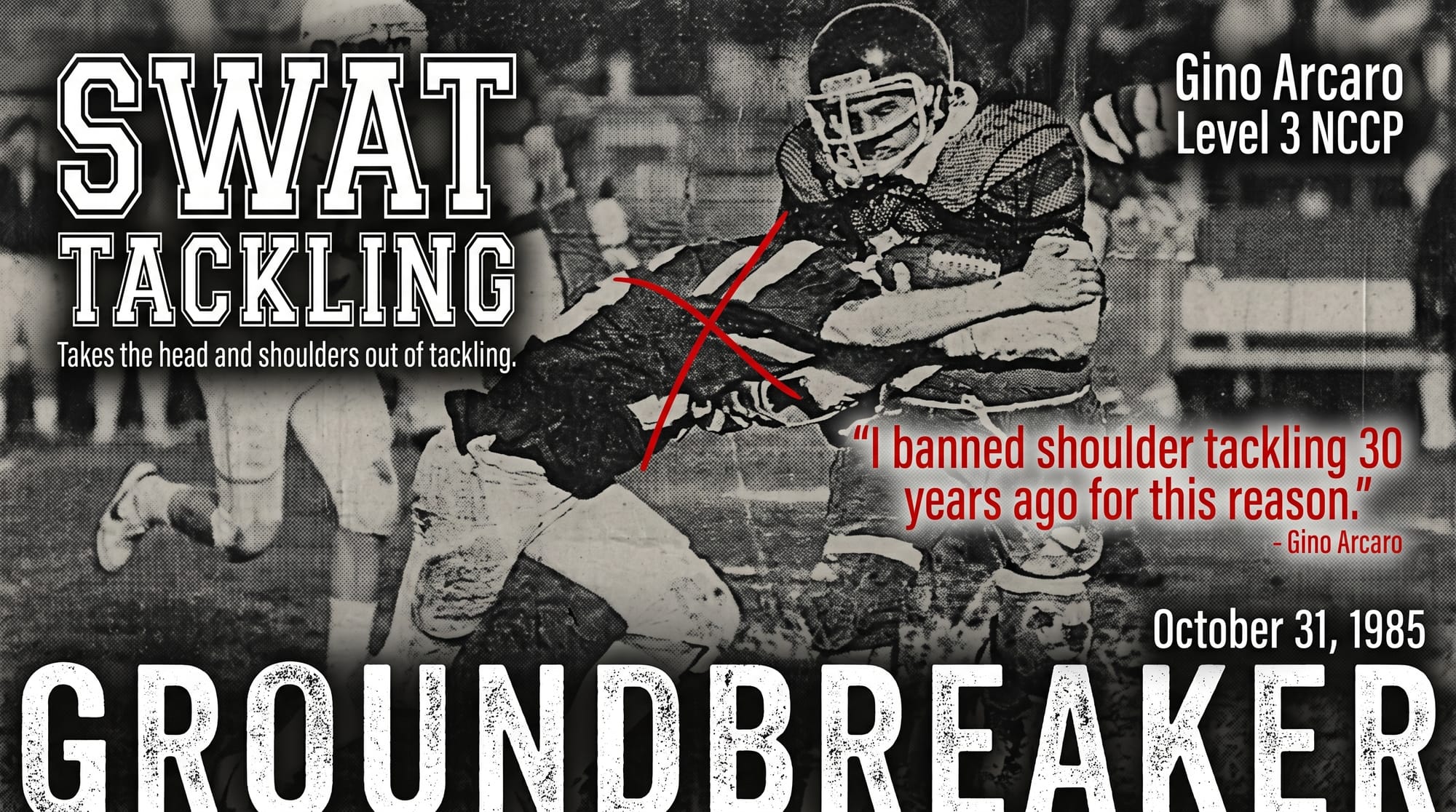
Player safety and the mitigation of catastrophic head injuries represent the single most urgent issue facing modern football at all levels. As medical research continues to document the severe long term effects of traumatic brain injuries and chronic traumatic encephalopathy, parents, coaches, and administrators are demanding systemic changes to the game. In SWAT Tackling (SWAT Football Book 3), veteran head coach, police detective, and physical strength practitioner Gino Arcaro presents a proven mechanical solution that eliminates head and shoulder contact from the tackling equation.
Published as a practical tactical guide and instructional program, SWAT Tackling is not a collection of abstract theories or wishful thinking. It outlines a proprietary tackling methodology that Arcaro developed and implemented beginning in 1985 after banning traditional shoulder tackling from his programs. Over a thirty year coaching tenure spanning high school, college, and semi-pro competition, Arcaro teams produced an unprecedented defensive safety record: zero neck breaks, zero fatalities, and zero reported concussions on defense. By substituting dangerous head-first collisions with a powerful chest contact model derived from foundational weightlifting mechanics, this system provides football coaches with a clear roadmap to keep players safe while winning championships.
The Flaws of Traditional Shoulder Tackling
For generations, conventional football coaching manuals instructed defenders to place their head across the ball carrier body and strike through the target with the shoulder pad. Arcaro identified this widespread orthodoxy as both biomechanically inefficient and dangerously irresponsible.
When a tackler drops their level to lead with the shoulder, the cervical spine is exposed to violent, compressive shock if the ball carrier changes direction or lowers their helmet. Leading with the head and shoulder places the tackler in a posture of acute anatomical vulnerability. Furthermore, shoulder tackling frequently results in glancing blows, missed arm tackles, and compromised leverage against physically dominant runners.
Arcaro recognized that continuing to teach traditional contact mechanics represented an unacceptable legal liability for coaching staffs and an unnecessary hazard for student athletes. Decades ahead of modern tackling reforms, Arcaro engineered the SWAT chest tackle to fundamentally remove the head and neck from the collision point.
Biomechanical Foundation of the SWAT Chest Tackle
The central innovation presented in SWAT Tackling is the direct transfer of basic strength training movements into on field contact mechanics. Arcaro anchors the technique in two of the most powerful movements in human performance: the barbell back squat and the flat bench press.
1. Power Generation from the Ground Up
True defensive tackling power does not originate in the neck or shoulder joints; it originates in the feet, hips, and posterior chain. In the SWAT system, defenders approach the ball carrier with a low, balanced center of gravity identical to the descent of a power squat. As the defender closes the distance, they explosively extend the hips, driving force from the ground upward through the legs.
2. Chest First Impact and Kinetic Transfer
Instead of leaning forward with an outstretched shoulder, the tackler delivers initial impact square through the center of the chest. This posture mimics the locked, braced position of a bench press lockout. Because the chest serves as a wide, fortified contact surface supported by the entire skeletal core, the head and cervical spine remain upright and completely outside the collision zone, regardless of the angle of pursuit.
3. The Guaranteed Upward Lift
By combining upward hip drive with a centered chest strike, the defender transfers energy into the torso of the ball carrier. This natural upward vector lifts the opponent center of gravity off the turf, neutralizing their forward momentum instantly. Rather than absorbing a concussive shock, the tackler expresses controlled athletic power that terminates plays cleanly on contact.
Decades of Real World Safety and Liability Reduction
Modern school boards, athletic directors, and youth league organizers face growing legal scrutiny regarding concussion management and tackling instruction protocols. Teaching outdated, high risk techniques exposes coaching staffs and educational institutions to devastating legal liabilities.
SWAT Tackling delivers an operational blueprint that protects both players and organizations. Arcaro three decade record of zero reported concussions on defense proves that injury prevention does not require compromising defensive aggressiveness. When defenders trust that their technique will not result in neck trauma or head injury, they play with greater speed, decisiveness, and physical confidence. Safety and winning are not mutually exclusive outcomes; proper mechanics accomplish both simultaneously.
Author Credentials and E-E-A-T Credibility
Search algorithms and coaching staffs require substantiated authority when evaluating sports safety literature. Gino Arcaro brings exceptional, verifiable credentials across competitive athletics, tactical operations, and public safety:
- Forty Seasons of Head Coaching Experience: Arcaro served as head coach across forty seasons at the high school, CIS university, and semi-pro football levels, originating and testing the complete SWAT Football system under real game conditions.
- Impeccable Player Safety Record: Across thirty years of teaching the SWAT chest tackle, his defensive units experienced zero neck injuries, zero broken cervical vertebrae, zero fatalities, and zero defensive concussions.
- Law Enforcement and SWAT Operator Background: Entering the police force at age eighteen, Arcaro advanced to tactical SWAT team operator and criminal detective by age twenty six, applying crisis risk mitigation and tactical discipline to athletic safety.
- Academic Authorship and Higher Education: Following fifteen years of active police service, Arcaro taught police studies for twenty years at the college level, authoring six foundational criminal justice textbooks used in institutions across Ontario.
- Advanced Academic Qualifications: Arcaro holds a Master of Education degree, an undergraduate degree in social sciences, and a Level 3 NCCP Coaching certification.
- Lifelong Physical Fitness Leadership: With over forty three consecutive years of natural weight training, Arcaro founded X Fitness Welland Inc., authored the strength manual eXplode, and produced the SWAT Tackling instructional video series featured on SWATFootball.ca.
This unique combination of tactical risk management, formal educational pedagogy, and decades of on field gridiron coaching ensures that SWAT Tackling delivers proven, reliable instruction.
Implementation Guide for Football Coaches
To successfully install the SWAT chest tackling system across a football program, coaches should follow a structured progression throughout spring camp and pre-season practices:
- Step One: Chalk Talk and Visual Realignment. Introduce film sessions showing the anatomical hazards of traditional shoulder tackling alongside demonstrations of the SWAT chest strike.
- Step Two: Weight Room Integration. Reinforce the mechanical link between the squat, bench press, and tackling posture, showing players that gym strength is directly expressed on the field.
- Step Three: Static Contact Drills. Practice the chest engagement posture without pads against static tackle dummies, emphasizing head placement behind and away from the pad level.
- Step Four: Angle Pursuit and Approach Tracking. Progress to half speed tracking drills where defenders approach ball carriers from multiple angles, ensuring the chest remains the primary strike plate.
- Step Five: Live Full Speed Execution. Graduate to controlled full speed drills, rewarding players who maintain an upright cervical spine and execute clean upward lifts.
Who Should Read SWAT Tackling
- High School and Youth Football Coaches: Leaders seeking an accredited, safety certified tackling progression that eliminates head trauma and reassures concerned parents.
- Defensive Coordinators and Position Coaches: Tactical instructors looking for precise mechanical drills to improve open field tackle completion rates.
- Athletic Directors and League Commissioners: Administrators working to insulate their sports programs from concussion related legal liabilities.
- Football Players and Parents: Athletes and families seeking objective evidence that gridiron football can be played physically without risking catastrophic head or spinal injuries.
Frequently Asked Questions
Is the SWAT chest tackle effective against larger ball carriers?
Yes. By driving upward from the hips and using the chest to lift the runner center of gravity, the SWAT tackle neutralizes size and forward momentum more effectively than an isolated shoulder hit.
Does this system require purchasing specialized field equipment?
No. The SWAT chest tackle relies on fundamental human mechanics and can be taught using standard tackling dummies, shields, and routine practice field setups.
Is there an instructional video to accompany the book?
Yes. An instructional DVD and digital streaming video demonstrating live drills from start to finish is available alongside the publication at SWATFootball.ca.
Where can readers purchase SWAT Tackling (SWAT Football Book 3)?
The publication is issued by Jordan Publications Inc. and is available in digital Kindle format on Amazon as well as through the author platforms at SWATFootball.ca and ginoarcaro.com.
Conclusion
Football does not need to be an exercise in catastrophic physical risk. The crisis of concussions in the sport is not an inevitable byproduct of the game; it is the consequence of flawed, outdated tackling instruction. In SWAT Tackling (SWAT Football Book 3), Gino Arcaro provides an indisputable, thirty year case study proving that football can be played aggressively, competitively, and safely. By replacing the dangerous shoulder hit with the biomechanically superior chest tackle, coaches can protect their athletes, eliminate legal liabilities, and build championship defensive units. For any coach committed to the long term survival of the sport and the welfare of their players, this manual is an urgent, essential read.