In frontline policing, an officer rarely steps into an environment of absolute certainty. Calls for service arrive as fractured broadcasts: an intrusion alarm triggered at a commercial business at 3:00 a.m., an unverified 911 distress call, or a chaotic report of a residential break and enter. In these initial moments, an investigator operates under severe practical restrictions: limited time, incomplete facts, and substantial personal risk.
Yet every operational decision—whether to detain, arrest, enter a building, or draft a search warrant—must withstand strict judicial scrutiny under the Canadian Charter of Rights and Freedoms. A procedural flaw during apprehension, evidence intake, or warrant drafting can lead to crucial evidence being excluded under Section 24(2) of the Charter
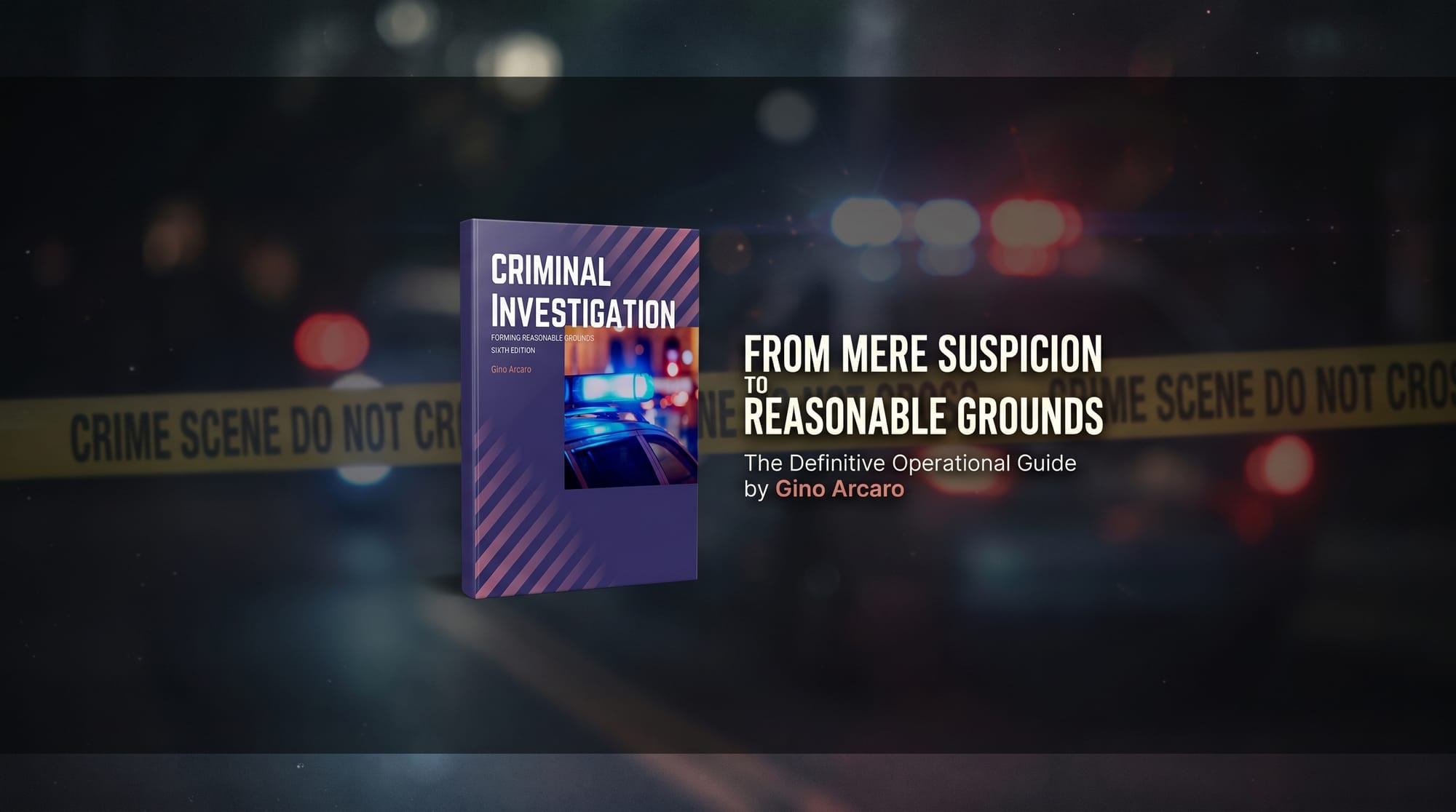
In Criminal Investigation: Forming Reasonable Grounds (6th Edition, Jordan Publications Inc., ISBN: 978-1-927851-17-3), author, former police detective, and veteran college professor Gino Arcaro delivers a battle-tested operational textbook. Drawing on 15 years of frontline and major case detective experience and 20 years of law enforcement instruction, Arcaro provides a structured decision-making methodology to help officers translate street encounters into unassailable court convictions.
The Legal Continuum: Mere Suspicion vs. Reasonable Grounds
A recurring reason for evidence exclusion in trial courts is an officer's failure to distinguish between an intuitive hunch and lawful authority. Under Canadian criminal jurisprudence and Section 495 of the Criminal Code, police beliefs exist along a precise legal spectrum:
- Arbitrary (Zero Certainty): Actions taken without any factual basis or justifiable rationale. Unlawful for detention or arrest.
- Mere Suspicion (Weak Certainty): An exploratory suspicion based on intuition or circumstantial observations that lead to multiple logical conclusions. Crucially, Section 495 of the Criminal Code grants no authority to arrest or lay an Information on mere suspicion.
- Reasonable Grounds (Strong Certainty): The statutory and constitutional standard required to arrest without a warrant, obtain search warrants under Section 487, and lay criminal charges. It exists only when the totality of objective facts leads to a single logical conclusion connecting a specific person to an offence.
- Find Committing (Absolute Certainty): When a peace officer directly observes the actus reus of an offence taking place.
The 3 Cs Rule for Forming Reasonable Grounds
To remove guesswork, Gino Arcaro defines the '3 Cs Rule.' To formulate lawful reasonable grounds, an investigator must possess at least one of the following concrete evidentiary elements:
- Confession: A voluntary, legally obtained admission of guilt to any person (citizen or police).
- Credible Eyewitness: At least one credible witness who observed the offence and can identify the perpetrator.
- Circumstantial Evidence: An objective factual matrix that rules out competing innocent explanations and points to only one logical conclusion.
The Base Investigative Decision-Making (IDM) Model
An investigation is not a random collection of tasks; it is a structured problem-solving pathway that bridges the gap between the uncertainty of an occurrence and the certainty of a solution. Arcaro's Base IDM model outlines core objectives every investigator must execute:
- 1. Maximize Volume of Evidence: Collect all physical items and witness accounts, both admissible and inadmissible, during preliminary phases to build complete contextual awareness.
- 2. Predict Admissibility: Screen collected evidence against statutory rules, eliminating conscriptive material and hearsay before trial filing.
- 3. Prove Facts-in-Issue: Establish identity, jurisdiction, time, date, actus reus, and mens rea beyond a reasonable doubt.
- 4. Eliminate Evidentiary Gaps: Utilize Locard's Exchange Principle (Transfer Theory) to trace the physical movement of impressions, fibres, and biological substances between victim, offender, and scene.
- 5. Exercise Proportionate Discretion: Apply the Supreme Court of Canada's guidelines in R. v. Beaudry (2007) and Hill v. Hamilton-Wentworth Regional Police Services Board (2007). Any decision not to charge must be objectively justifiable in the public interest and never motivated by personal convenience or the desire to evade civil liability.
Overcoming Tunnel Vision: The Basic Investigative Sequence (BIS)
Investigative tunnel vision—focusing stubbornly on a single suspect while disregarding alternative possibilities—remains one of the leading causes of wrongful convictions in Canadian legal history. Citing the findings of the Thomas Sophonow Inquiry and the Justice Archie Campbell Bernardo Investigation Review, Arcaro establishes the Basic Investigative Sequence (BIS) as a systematic safeguard.
Known as the 'Beam of Suspicions,' the BIS directs investigators through five outward-expanding stages, moving from the smallest, most familiar group to the largest, least probable group:
- Step 1: Validate the Complaint: Never assume an occurrence is authentic without verification. Because staged crime scenes and false reports (Public Mischief under Section 140 C.C.) are common, an officer must verify that the offence actually occurred, at the reported location, and in the reported manner.
- Step 2: Suspect Relatives: The closest circle with the highest degree of familiarity, access, and potential interpersonal conflict.
- Step 3: Suspect Acquaintances: Evaluating the victim's broader personal and commercial circle, categorized via the B.E.S.T. network (Business, Education, Social, Temporary).
- Step 4: Suspect Non-Acquaintances: Offenders who had no personal relationship with the victim, but acquired detailed familiarity through pre-offence scouting and deliberate planning.
- Step 5: Suspect Strangers: Statistically, random crimes committed by complete strangers without prior planning are exceedingly rare. Treating a crime as a random stranger attack at the outset reverses sound investigative logic and frequently leads to unsolved cases.
First Officer Responsibilities: The FOUR + RDM Framework
The first uniform patrol constable on the scene carries the heaviest legal and tactical burden. Dispelling Hollywood misconceptions about crime scene analysis, Arcaro demonstrates that forensic integrity depends entirely on initial frontline containment.
The first officer must immediately execute the 'FOUR' uniform duties:
- Injuries: Prioritize human life. Provide emergency treatment and eliminate immediate threats. Protection of human life strictly supersedes physical evidence collection.
- Interviews: Conduct preliminary, open-ended exploratory interviews to separate complainants, witnesses, and potential suspects before contamination occurs.
- Communication: Broadcast immediate, actionable suspect descriptions and travel directions across the platoon to coordinate perimeter interception.
- Crime Scene Protection: Establish defined inner and outer perimeters, establish a single authorized entry path, maintain an unbroken log of all personnel, and secure physical continuity to prevent evidence exclusion under Section 8 of the Charter.
Frequently Asked Questions (FAQ)
Question: What is investigative negligence under Canadian law?
Established by the Supreme Court of Canada in Hill v. Hamilton-Wentworth Regional Police Services Board (2007), investigative negligence allows wrongfully accused individuals to sue the police if an investigation falls below the standard of a reasonable officer, such as laying charges based merely on suspicion without formulating reasonable grounds.
Question: Can inadmissible evidence be used to formulate reasonable grounds?
Yes. Under Supreme Court precedents like R. v. Debot, an officer may utilize both admissible and inadmissible information (including radio dispatch hearsay, suspect criminal records, and non-expert opinions) to establish reasonable grounds for a warrantless arrest under Section 495 C.C. However, only strictly admissible evidence can be presented in court to prove guilt.
Question: Why is crime scene validation critical before suspect identification?
Offence fabrication often stems from insurance fraud, personal disputes, or efforts to conceal other misconduct. Validating the physical crime scene against the reported facts ensures police do not direct invasive investigative powers against innocent citizens based on simulated claims.
Equip Yourself with Practical Investigative Mastery
Whether you are a Police Foundations student preparing for hiring assessments, a frontline recruit navigating your first year of patrol, or an experienced detective handling complex warrant applications, professional mastery of procedural law is non-negotiable.
Final Text] Discover Gino Arcaro's comprehensive field manual and elevate your operational standards today: Order Criminal Investigation: Forming Reasonable Grounds (6th Edition) on the official book page