
Defensive Coordinators are asked this question
more than any other:
“How many high?”
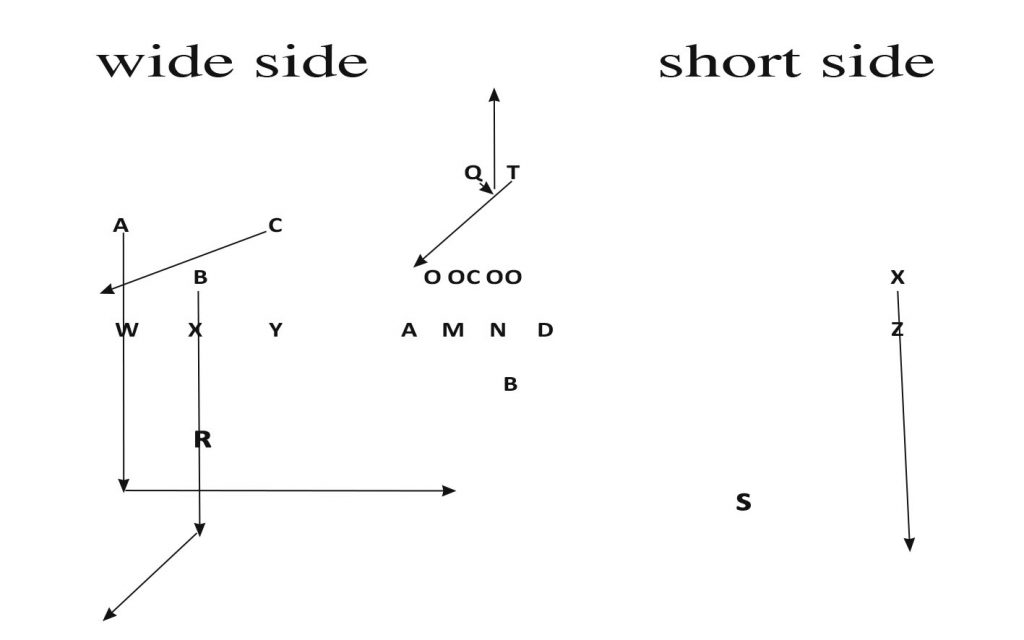
Defensive Coordinators have the biggest challenge in football history. If you can’t find a solution to the current problem of postmodern offenses, you will get lit up. Without a solution, your defense will get bombed, run over, or both. The DC job has never been at a higher risk of survival than now. The current problem for defensive coordinators is preparing for “high-volume.” The spread of formations, passing speed and tempo, all without compromising the power of interior running are under consideration. Our solution for the high volume of formations, of passing, and tempo was thinking as far outside the box as possible – literally and figuratively. I changed the number of “high” safeties.
The above diagram shows one example of our solution that started as a work in progress in 1991. R & S in the diagram look like two high safeties but they are not exclusively high safeties. They are high-low defenders. We don’t even call them safeties any more in my SWAT Defensive system, but we use the term to teach rookies to make the adjustment to our SWAT system. Even though R & S are not high safeties in the above diagram, they can be, depending on decisions made immediately before the snap and immediately after the snap.
Up to 1991, I was stuck in my defensive ways. Between 1984 and 1991, I strictly used one high safety or none. It worked. Championship rings, perfect seasons, and the development of underdogs who played beyond their natural talent level. The reason it worked was that the offenses we faced from 1984-91 made the decision simple for us. They used “low-volume” strategies–low numbers of formations, motion/shifts, plays, passing, and tempo changes. Most of our opponents did not pass efficiently enough to threaten our defensive ideology. Not one offense we faced used a no-huddle. We never even faced a single-back formation during that time. One high safety was enough. So was none. Things changed midway during 1991, when I coached two teams per year, as a high school head coach and as defensive coordinator for a summer AAU-style 22-under program that served as an alternative for college. Nothing ever changes until a compelling need arises. That’s what happened to us in the summer of 1991.
The best thing that happened to my defensive coordinating career was preparing to play an opponent that passed for 603 yards and scored 63 points the previous week, spreading formations with four and five receivers, spreading the ball around to every receiver on the field, at every conceivable location, without compromising the strength of their ground attack. Your defensive coordinator career evolves at the same speed as your opponents’ offense. The more they throw at you, the more you learn, the more you evolve, and the more you understand how to coordinate a defense while gaining a deeper comprehension of coordinating an offense. The best way to learn how to coordinate an offense is to defend against and attack as many offensive ideologies as possible. Coordinating defenses against high-volume offenses gives you the equivalent of graduate-degree knowledge of offense.
Film study of our high-volume 1991 opponent showed what I had never seen before–an offense that thought so far outside the box until the box disappeared. My solution wasn’t to scrap my system but to add another component. The main question then is what I believe is now the #1 question facing defensive coordinators: “How many high safeties?”
My solution for that game was 2 “high-low” safeties. The following is a summary of our “2 high-low” safety component:
- The primary objective of adding another high safety wasn’t to protect deep. It was to adapt before the snap to change the defensive formation without changing our fundamental approach to proactive defense. Adaptation and reactive defense are two separate concepts. Once you react to an offense, your defense loses everything–identity, ideology, instinct, intuition, even defensive IQ. Your defense ends up playing catch-up, which our research shows has an over 80% result of losing and losing big. Adaptation is a different story. Adaptation makes a no-huddle call–the defensive call at the LOS as opposed to a blind call made in the huddle that likely requires a defensive audible. Adaptation allows you to lead, not follow. That’s the key to proactive defense.
- Two-deep coverage is a part of the system but never the base coverage. The main objective is to position the two safeties where they are needed on a specific play. That required a mental makeover of how we viewed the safety position, including their conventional job description, their alignment, and assignment. The traditional 10+ yards off the LOS is not the basis of our 2 high-low approach. We designed a new level on defense called the O-Zone, the area where the offense normally doesn’t see defenders aligned in. The above diagram shows one example of O-zone mentality. R & S are positioned lower and wider than the conventional 2 high safeties. The diagram is not our base but an adaption–a proactive defensive call made at the LOS within the context of that moment.
- A high-low safety is a multi-dimensional player without a title. He is not a defensive back. He has to play at every defensive level, vertically and horizontally. His primary job is not coverage. He is a dual-responsibility player equally capable of playing in space and in a crowd. His most important skill is open-field tackling. No other skill is more important for a high-low safety.
- We re-defined the concept of the “box.” What matters is who can enter the post-snap box and when, not who is in the pre-snap box. Our defensive philosophy hinges on the notion of dynamic-entry and dynamic exit–coming out of nowhere to attack inside the box and outside the box. What matters is how fast we can move in and out of the box to pursue the ball. The actual number of defenders lined up in the box is overrated. What matters is who can move in the box and get out, in order to get the job done.
- The proliferation of spread offenses forced us to look outside the box for secondary boxes. What this means is that spread offenses create more than just one conventional box–a traditional belief. Break out film of your opponent and see for yourself. The box is an area of engagement, an area with the highest threat level. You’ll see that the conventional box is no longer alone. There’s more than one box on the field.
- Dynamic entry defense is predicated of the unexpected. Not trickery, just the unconventional. Dynamic entry is applying fast full-force pressure to enter the offense’s highest threat level. It’s the equivalent of a SWAT team knocking down several doors at once or busting out a window or even an entire wall. Whatever it takes, from wherever it takes. Dual meaning.
- Offenses have conditioned themselves to expect familiar defensive tactics and strategies. For example, many offenses have an antiquated definition of what “deep-help” means. Defenses are not bound by the same restrictions as offenses are. That’s your biggest advantage as a defensive coordinator. Take full advantage of the rulebook. You get to set the defensive board any way you like. Offenses don’t. What matters is how far outside the box you’re willing to think.
#Peace